👩🔬 For applicants
The Collector App for entering the data, the R package for profile creation, and the Profile Builder website where end-users can retrieve their profile are under development and not finalized yet. Things might change substantially in the near future. If you want to use the RESQUE framework in practice please contact us.
How can I enter my data and get a profile?
Choose the option that matches your use case:
- Enter the data in the RESQUE Collector App of the specific hiring committee (usually committees provide a custom link). Committees can choose different sets of indicators and set a limit of how many publications should be minimally and maximally provided.
- Save the data as a local
jsonfile (Save to file …). - Send the exported
jsonfile from Step 2 to the committee. - (optional, for your personal use) Open the RESQUE Profiler, upload the
jsonfile, and generate the profile as an html file. The committee will create the profile themselves based on yourjsonfile.
Important notes:
Only publications with sufficient data on the indicators can be fully processed (see “Problems” in the top right corner of the Collector App - if there no problems are shown, everything is fine.). Hence, bulk importing publications from ORCID without adding the indicator information does not help; such publications will be excluded from the profile.
- Select the publications you want your profile to represent and enter them in the generic RESQUE Collector App.
- Save the data as a local
jsonfile (Save to file …). - Upload the file to the RESQUE Profiler to create an html profile.
- Add the resulting profile to your CV or personal website.
This option is useful when you want to present a concise RESQUE profile of your research even without an explicit committee request.
- Enter the information for a publication in the generic RESQUE Collector App.
- On the top right of the middle pane, click the “Print” button. In the print dialog of your browser, you can export the print as a PDF file.
- (optional, but recommended) Save the data as a local
jsonfile (Save to file …), so that you can later change values.
You can use that report as an in-depth quality checklist. Include it when you submit your manuscript to a journal, or include it in the supplementary material. Some journals already require an “Open Research Practice” statement - with this RESQUE checklist, you get a much more detailed summary of your open research practices.
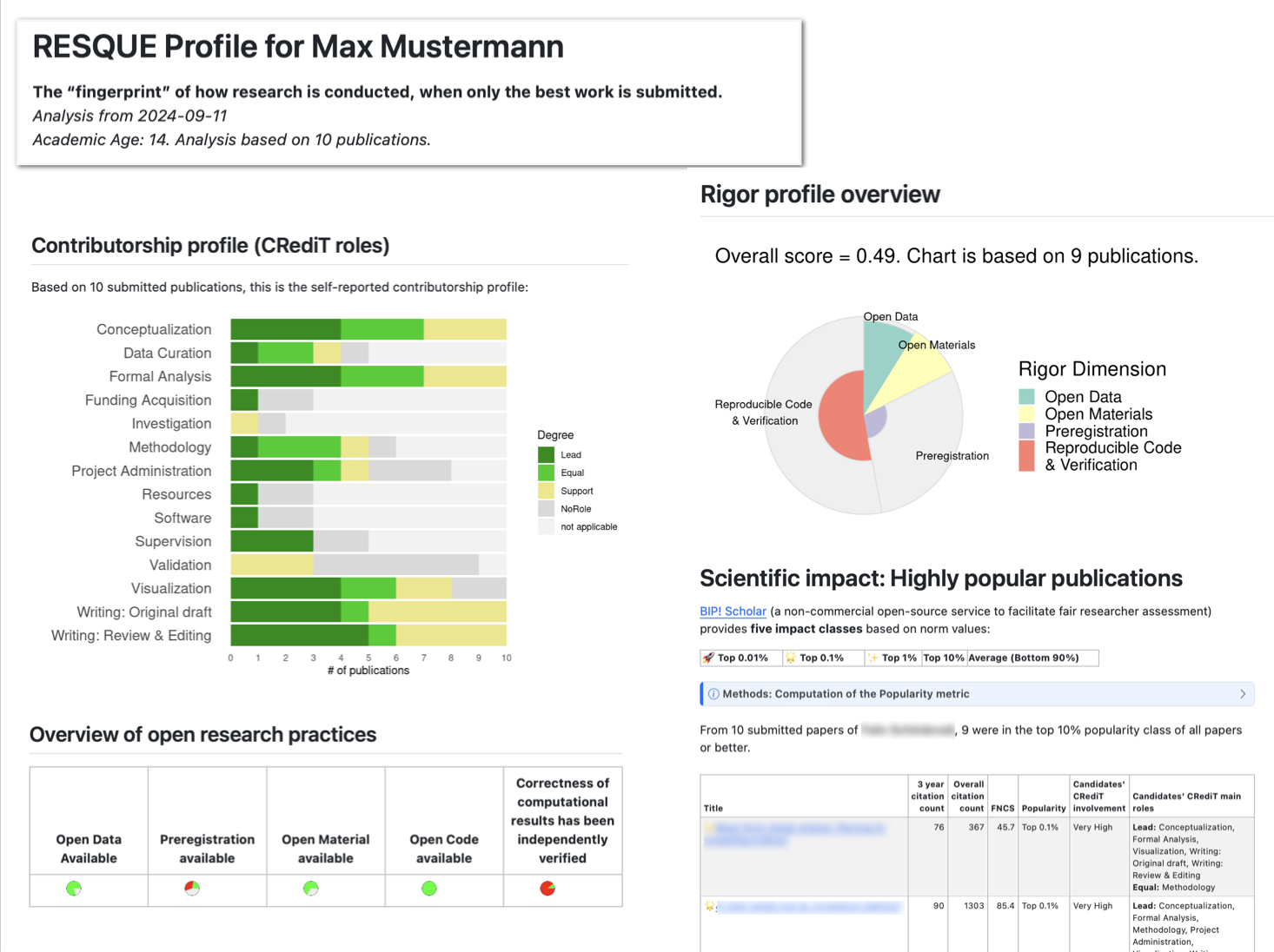
Interactive Example
Open the Demo Profile
Explore a full RESQUE example profile in your browser. Use this to see the final layout applicants and committees receive.
Go to demo profile